


Table of Contents
So You Just Graduated and the Bill Came. Now What?
That first loan statement hits your inbox and your stomach drops. Maybe you haven’t found a job yet. Maybe rent is eating up most of your paycheck. Or maybe you just realized you borrowed more than you can reasonably pay back.
You’re not alone.
According to the Consumer Financial Protection Bureau (CFPB), 63 percent of student loan borrowers have reported difficulty making their payments at some point, and more than one in three have missed at least one payment. Total student loan debt in the U.S. now exceeds 1.8trillion,andtheaveragefederalborrowerowesnearly1.8trillion,andtheaveragefederalborrowerowesnearly40,000.
The question is: who do you actually call when the money isn’t there?
Here’s exactly who you need to contact, step by step.
Key Takeaways
- Contact your loan servicer immediately if you can’t make your student loan payment.
- For federal loans, find your servicer at StudentAid.gov or call 1-800-433-3243.
- Income-driven repayment plans can lower your payment to as low as $0 based on what you earn.
- For private loans, call your lender directly. They have fewer options, but some may offer temporary relief.
- Ignoring missed payments leads to credit damage, default, wage garnishment, and tax refund seizure.
- If your servicer won’t help, file a complaint with the CFPB (1-855-411-2372).
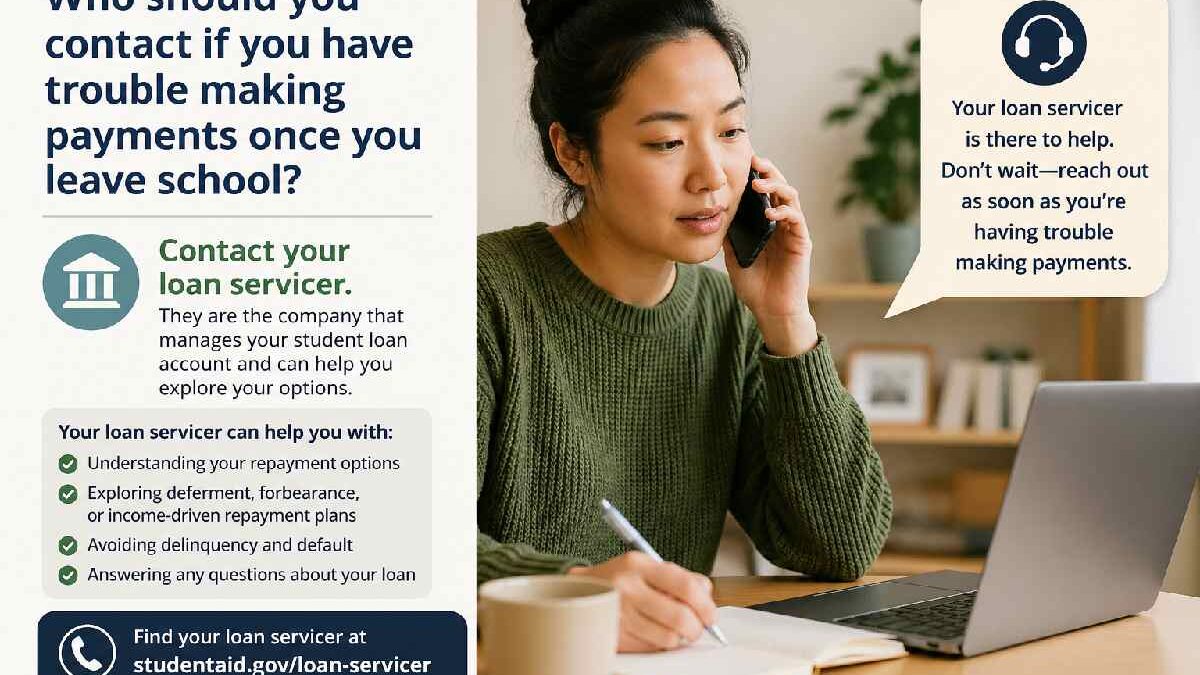
Who Should You Contact If You Have Trouble Making Payments Once You Leave School?
Let me give you the direct answer first, then explain why it matters.
Your loan servicer.
That’s it. That’s the answer you need for tests, for exit counseling, and for real life.
Your loan servicer is the company that handles your billing, processes your payments, and keeps track of your loan balance. If you have federal student loans, the U.S. Department of Education contracts with private companies (like Aidvantage, Edfinancial, Mohela, or Nelnet) to manage those accounts. If you have private loans, your servicer is the bank or lending company you borrowed from, such as Sallie Mae, SoFi, or Discover.
The servicer’s job is to collect your payments and help you stay on track. That means they’re also the one you need to call when you can’t stay on track.
Why Your Loan Servicer and Not Someone Else
It’s tempting to reach out to other people. Your school’s financial aid office helped you get the loans in the first place. Your parents might be willing to help. A friend who seems “good with money” might have advice.
But here’s the thing: none of those people can change your payment terms, approve a deferment, or switch you to a different repayment plan. Only your loan servicer has the authority to modify your account.
Your school’s financial aid office can point you in the right direction, especially if you’re still enrolled or just graduated. But once you leave school, they can’t do much else. Exit counseling (which you’re required to complete before you graduate or drop below half-time enrollment) is where you get that handoff from your school to your servicer.
Your loan servicer, on the other hand, can do things like:
-
Lower your monthly payment through an income-driven plan
-
Pause your payments temporarily through deferment or forbearance
-
Explain your options for loan consolidation
-
Help you avoid default
They’re literally paid to help you with this. Use them.
Who to Contact for Federal Student Loans vs. Private Student Loans
Here’s where people get confused. Federal loans and private loans are not the same, and the person you contact can be different.
Federal student loans
For federal loans, your servicer is the company the Department of Education assigns to your account. You can find out who that is in about two minutes:
-
Go to StudentAid.gov
-
Log in with your FSA ID (the same username and password you used for the FAFSA)
-
Look for “My Aid” or “Loan Servicer Details”
If you can’t log in or can’t find your servicer, call the Federal Student Aid Information Center at 1-800-4-FED-AID (1-800-433-3243) . They’ll help you identify who your servicer is.
Once you have your servicer’s name, call them directly. Most federal loan servicers have dedicated teams for repayment assistance. Be prepared to explain your financial situation honestly.
Private student loans
Private loans are different. There are no standard federal protections or income-driven repayment plans. Every lender sets its own rules.
If you have private loans, contact your lender directly. Look at your monthly statement for a customer service number. If you can’t find it, check your online account or the lender’s website.
Some private lenders offer modified repayment plans, especially if you ask before missing a payment. They might agree to a temporary interest-only period or a short forbearance. But they are not required to help. The key is to call before you fall behind.
One important warning: do not refinance federal loans into a private loan just to lower your payment. Once you do that, you lose access to all federal protections, including income-driven repayment, deferment, forbearance, and forgiveness programs. That move is permanent.
What to Say When You Call Your Loan Servicer
Pick up the phone. I know it’s uncomfortable. Do it anyway.
Here’s a simple script you can adapt:
“Hi, my name is [your name]. I’m having trouble making my student loan payments. My account number is [your number]. Can you walk me through my options for lowering my payment or temporarily pausing it?”
That’s it. You don’t need to explain your whole life story. Just tell them you’re struggling and ask what’s available.
Be ready to answer questions about your income, your employment status, and your family size. For income-driven repayment plans, you may need to provide recent tax returns or pay stubs.
If the first person you talk to isn’t helpful, ask to speak with a supervisor or a repayment specialist. Some customer service representatives are not well trained. Keep pushing until you get someone who can actually help.
Your Options Once You Get Them on the Phone
Once you reach your servicer, here are the main options they might offer you.
Income-Driven Repayment (IDR) Plans
If your federal loan payments are too high compared to your income, you can switch to a plan that caps your payments at a percentage of your discretionary income. For many borrowers, that payment can be as low as $0 per month.
Important update for 2026: The student loan system is changing. A new law, the One Big Beautiful Bill (OBBB), created a new plan called the Repayment Assistance Plan (RAP). Starting July 1, 2026, new borrowers will have only two repayment choices: RAP or a standard term plan. RAP sets your payment at 1% to 10% of your income, or a flat 10permonthifyouearnlessthan10permonthifyouearnlessthan10,000 per year.
Existing borrowers can stay on Income-Based Repayment (IBR) or switch to RAP. Other plans like PAYE, ICR, and SAVE are being phased out.
Deferment and Forbearance
If you need a temporary break, you can ask for deferment or forbearance. Both pause your payments, but they work differently:
| Feature | Deferment | Forbearance |
|---|---|---|
| Who qualifies | Specific situations (unemployment, economic hardship, military service) | Any financial difficulty (more flexible) |
| Interest on subsidized loans | Paid by government (in most cases) | Borrower pays all interest |
| Interest on unsubsidized loans | Borrower pays all interest | Borrower pays all interest |
| Maximum duration | Up to 3 years | Up to 12 months at a time |
Interest usually keeps growing during both types of pause. That means your balance will be larger when you restart payments. Use deferment or forbearance as a short-term bridge, not a long-term solution.
Consolidation
If you have multiple federal loans, you can combine them into one Direct Consolidation Loan. This gives you a single monthly payment and may extend your repayment term (which lowers your payment but increases total interest paid). Consolidation can also make Perkins loans or FFEL loans eligible for income-driven repayment plans.
Loan Forgiveness
If you work full-time for a government agency or a nonprofit, you might qualify for Public Service Loan Forgiveness (PSLF). After 120 qualifying payments, your remaining balance is forgiven. But keep in mind: starting in 2026, most student loan forgiveness counts as taxable income at the federal level. That “tax bomb” can be significant for large forgiven balances.
What to Do If Your Loan Servicer Won’t Help
Sometimes servicers drop the ball. They misapply payments, give bad advice, or just don’t answer the phone.
A 2024 CFPB report analyzing over 18,000 borrower complaints found widespread problems: payment processing errors, inaccurate bills, unhelpful customer service, and auto-pay debits that went horribly wrong — including thousands of dollars incorrectly taken from borrower accounts.
If that happens to you, don’t just give up. Escalate.
Step 1: File a complaint with the CFPB
The Consumer Financial Protection Bureau has a complaint portal at consumerfinance.gov/complaint. You can also call them at 1-855-411-2372. The CFPB handles both federal and private loan complaints. If your servicer is violating the law or just being impossible to work with, the CFPB can step in.
Step 2: Contact the FSA Ombudsman
The Federal Student Aid Ombudsman Group is a dispute-resolution service within the Department of Education. They handle federal loan disputes only. You can reach them at 1-877-557-2575 or through the online portal at studentaid.gov/feedback-ombudsman.
Step 3: Check if your state has a student loan ombudsman
Several states — including California, Connecticut, Maryland, and Washington — have their own student loan ombudsman offices. These state-level offices can sometimes get results faster than the federal options.
What Happens If You Do Nothing (And Why You Shouldn’t)
Let me be blunt. Ignoring the problem is the worst thing you can do.
If you miss a payment, your loan becomes delinquent. That gets reported to the credit bureaus. Your credit score drops. Late fees pile up.
If you go 90 days without paying, your servicer will report you as seriously delinquent. That makes it harder to rent an apartment, buy a car, or get approved for a credit card.
If you go 270 days without paying a federal loan, you enter default. That’s when things get really bad:
- The entire balance becomes due immediately (all of it, plus interest and fees)
- The government can garnish your wages — up to 15% of your paycheck
- The government can seize your tax refunds and federal benefits
- You lose eligibility for additional federal aid
In 2026, the U.S. Department of Education restarted aggressive collections on defaulted loans after a pandemic-era pause. As of October 2025, more than 5.5 million borrowers were in default. Wage garnishment notices are being sent out monthly.
The lesson: call before you miss a payment. Servicers are much more willing to work with you when you’re proactive.
Common Mistakes That Make Things Worse
I’ve seen people make the same errors over and over. Don’t be one of them.
Mistake #1: Ignoring letters and calls from your servicer. That doesn’t make the problem go away. It makes it grow.
Mistake #2: Paying a company that promises loan forgiveness for a fee. No legitimate servicer charges you to lower your payment or apply for forgiveness. This is a scam.
Mistake #3: Refinancing federal loans into private loans without understanding what you’re giving up.
Mistake #4: Waiting until you’re already in default to take action. By then, your options are much more limited.
Quick Reference: Who to Contact for Student Loan Trouble
| Situation | Who to Contact | Phone Number / Website |
|---|---|---|
| Don’t know your servicer | Federal Student Aid Info Center | 1-800-433-3243 / StudentAid.gov |
| Federal loan payment problem | Your loan servicer | Check your monthly statement |
| Private loan payment problem | Your private lender (Sallie Mae, SoFi, etc.) | Check your online account |
| Servicer won’t help or made an error | CFPB complaint portal | 1-855-411-2372 / consumerfinance.gov/complaint |
| Dispute about federal loan | FSA Ombudsman | 1-877-557-2575 / studentaid.gov/feedback-ombudsman |
Final Thoughts
You’re not a bad person because you can’t afford your student loan payment right now. Millions of people are in the same boat. The average borrower owes nearly $40,000. One in three borrowers has missed at least one payment. The system is hard, and the stakes are high.
But you have options. The first and most important step is reaching out. Call your loan servicer tomorrow. Not next week. Not “when things get better.” Tomorrow.
Tell them what’s going on. Ask for help. Most servicers have programs designed exactly for people in your situation. Use them.
And if the first person you talk to isn’t helpful, hang up and call back. Or escalate to the CFPB. Keep pushing until you get a solution that works for you.
You can get through this. But you have to make the call.
Frequently Asked Questions (FAQ)
Q: Who should you contact if you have trouble making payments once you leave school?
A: Your loan servicer. That’s the company that manages your student loan account and sends your bills.
Q: How do I find out who my loan servicer is?
A: Log into StudentAid.gov and look for “My Aid” or “Loan Servicer Details.” You can also call 1-800-433-3243.
Q: What’s the difference between deferment and forbearance?
A: Both pause your payments temporarily. Deferment is usually for specific hardships and may not charge interest on subsidized loans. Forbearance is more flexible but always accrues interest on all loan types.
Q: Can I lower my monthly payment permanently?
A: Yes, through income-driven repayment plans (for federal loans). These cap your payment at a percentage of your income. Starting July 2026, new borrowers will use the Repayment Assistance Plan (RAP).
Q: What happens if I just stop paying?
A: Your credit score drops, you’ll be charged late fees, and eventually you’ll go into default. Default can lead to wage garnishment, tax refund seizure, and losing eligibility for future federal aid.
Q: What if my loan servicer won’t help me?
A: File a complaint with the CFPB at consumerfinance.gov/complaint or call 1-855-411-2372. You can also contact the FSA Ombudsman for federal loan disputes at 1-877-557-2575.
Wikipedia Reference Link
Student loan – https://en.wikipedia.org/wiki/Student_loan
Federal Student Aid – https://en.wikipedia.org/wiki/Federal_Student_Aid