

Table of Contents
You Got That NIMS Accountability Question on Your Test
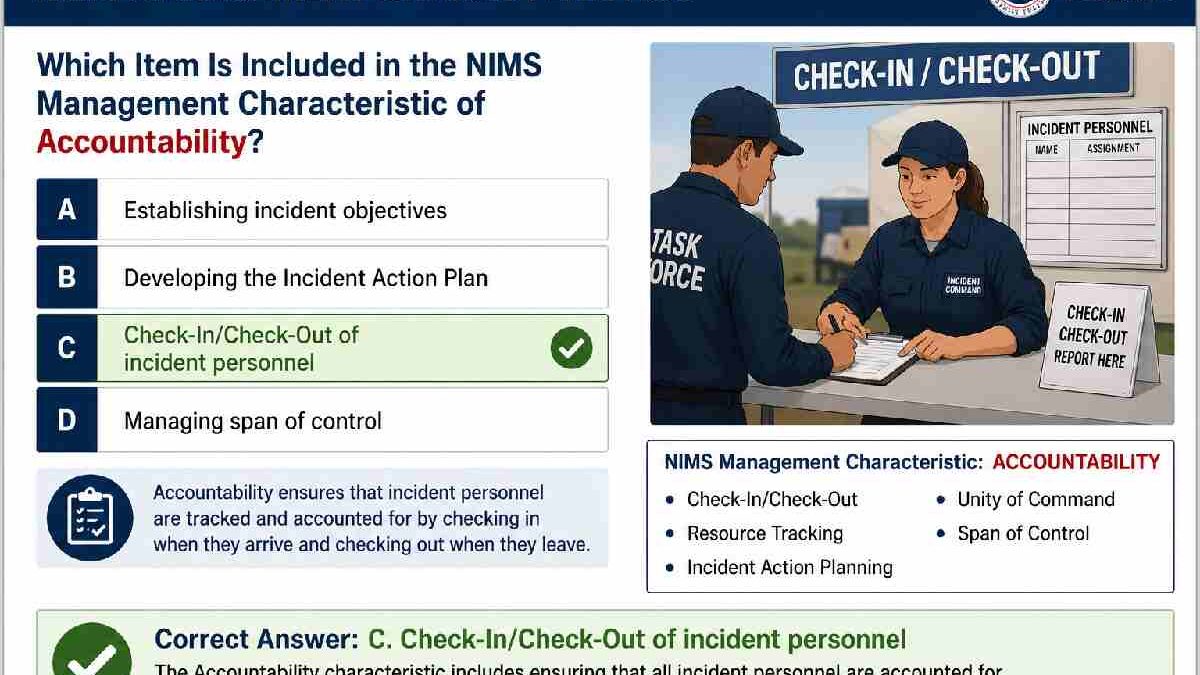
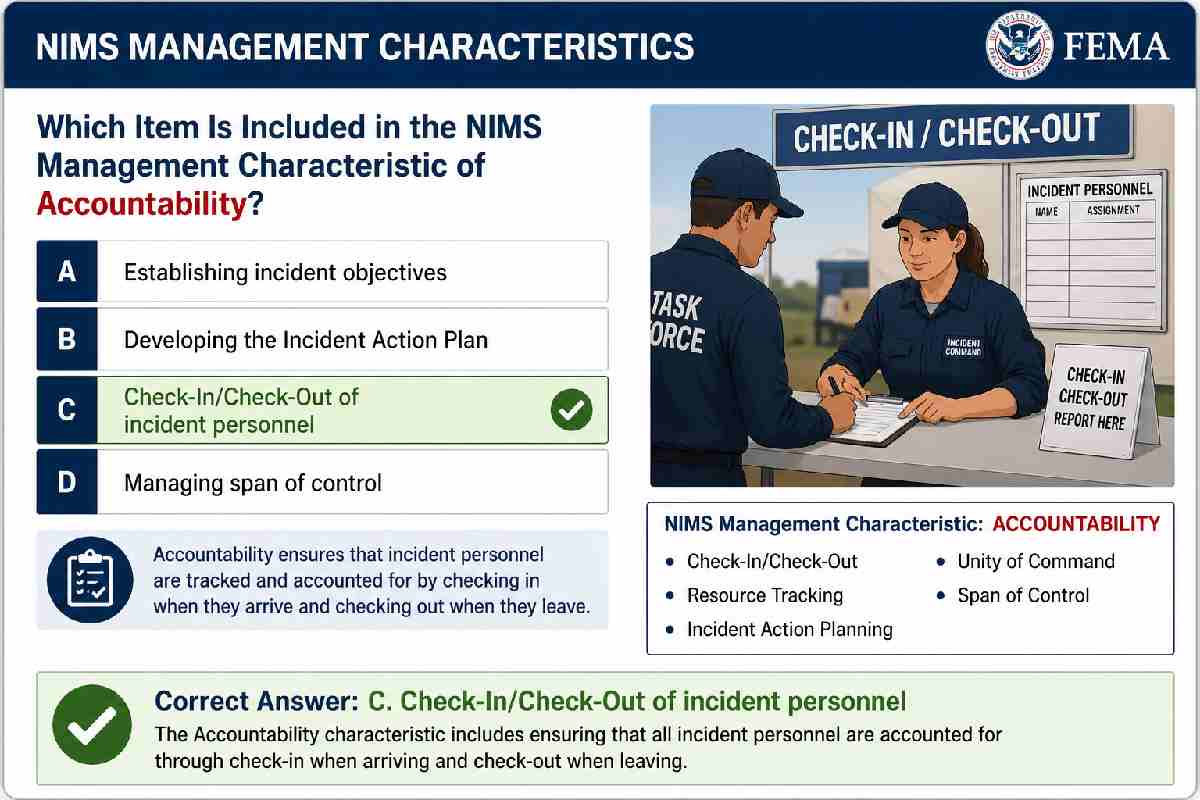
I remember staring at that question myself. “Which item is included in the NIMS Management Characteristic of Accountability?” You see four options. One of them is “Check‑In/Check‑Out of incident personnel.” That’s the one. Circle it. Move on.
But here’s the thing. If you just memorize that answer and never think about what it actually means, you’re missing the whole point of NIMS. And if you ever end up on a real incident – a wildfire, hurricane, train derailment, whatever – you’ll see why accountability isn’t just a test trick.
Let me break it down the way I wish someone had explained it to me.
Key Takeaways (because who doesn’t skim?)
- Test answer: Check‑In/Check‑Out of incident personnel.
- Real accountability has six parts, not one.
- Common screw‑ups: skipping check‑in, leaving without check‑out, using jargon, not updating status.
- Small incidents need accountability just as much as large ones.
- Everyone is responsible for their own accountability – not just the boss.
Who Actually Needs to Read This (be honest)
This is for you if:
-
You’re studying for FEMA IS‑100.C, IS‑200.C, or IS‑700.B.
-
You’re a new firefighter, EMT, cop, or emergency manager.
-
You’ve been in response for a while but never really got why check‑in is such a big deal.
-
You just want to pass the test and understand what you’re doing later.
If you’re an old‑school incident commander with 20 years on the job, you probably already know this stuff. But even then – I’ve seen veterans blow off check‑in because they were in a hurry. Don’t be that person.
What Accountability Actually Means (not the textbook definition)
Alright, so NIMS says accountability is “the ability to account for the location and status of all personnel and resources.” Fine. That’s the formal line.
But in plain English? It means no one gets lost. No one does their own thing without telling anyone. And if something goes wrong, you know exactly who was where and what they were doing.
Think of it like a really strict group project. Except instead of a bad grade, the penalty is someone getting hurt or a whole operation falling apart.
The One Item the Test Wants You to Pick
Let’s just get this out of the way. The question is: which item is included in the NIMS management characteristic of accountability?
The textbook answer from FEMA: Check‑In/Check‑Out of incident personnel.
Why? Because you can’t account for someone if you don’t know they arrived. And you can’t close out an incident if you don’t know they left. Check‑in starts the clock. Check‑out ends it.
I’ve seen crews roll up to a staging area, grab their gear, and head straight to the line without checking in. “We’re in a hurry,” they say. Yeah, I get it. But now command thinks you haven’t arrived yet. So they request another crew. Now you have twice as many people as you need, and nobody knows who’s who. That’s a mess.
But Here’s What the Test Doesn’t Tell You
Check‑in/out is the correct answer on the exam. But in real incident management, accountability is made of six parts, not one. You need all of them. If you miss any, the system leaks.
Here they are, plain and simple:
1. Check‑In/Check‑Out – We already covered that. Show up, sign in. Leave, sign out.
2. Incident Action Plan (IAP) – Every shift needs a written plan. It says who does what, when, and where. If you’re not following the IAP, you’re freelancing. And freelancing kills accountability.
3. Unity of Command – You report to one boss. Not two, not three. When a firefighter takes orders from a strike team leader and a division supervisor and a chief from another agency, confusion follows. And confusion means nobody knows who’s really responsible for you.
4. Personal Responsibility – This one’s on you. You have to check in. You have to read the IAP. You have to tell your supervisor if you move or stop for a break. No one can track you if you don’t help.
5. Span of Control – One supervisor should have no more than 3 to 7 people reporting to them. Ideally 5. If a boss has 15 people, they can’t keep track of all of them. Simple as that.
6. Resource Tracking – Not just people, but engines, chainsaws, ambulances, tents, everything. If you don’t know where your equipment is, you don’t really know what your people are doing either.
So yeah, the test answer is check‑in/check‑out. But if you stop there, you’re not really ready for the field.
Common Ways People Mess This Up (I’ve done some myself)
I’ll be honest – I’ve screwed up accountability more than once. Here are the usual mistakes.
Skipping check‑in “just this once.” Every time someone says that, they don’t check in. And then command spends an hour trying to find them. Don’t be that person.
Using nicknames or jargon on the radio. “Engine 42 is 10‑8 with 4 on board.” What does that mean to someone from another state? NIMS says use plain language. Say “Engine 42 is in service with four personnel.” Takes two extra seconds.
Leaving without checking out. You finish your shift. You’re tired. You just want to get to the tent and sleep. So you leave. Nobody stops you. But now the status board still shows you on scene. Later that night, someone asks “where’s Smith?” And everyone panics for an hour until someone remembers you left. I’ve seen this happen at least three times.
Not updating your location. You get reassigned from Division A to Division B. But you don’t tell anyone. Your old supervisor thinks you’re still in A. Your new supervisor doesn’t know you’re coming. If something happens, nobody can find you.
Myths People Believe (that get them in trouble)
| Myth | What’s actually true |
|---|---|
| “Accountability is just paperwork.” | No, it’s a real‑time process. Paperwork records it, but the process is ongoing every minute you’re on scene. |
| “Only the Incident Commander is responsible.” | Wrong. The IC sets up the system, but every single person has to follow it. You are responsible for yourself. |
| “Check‑in slows us down too much.” | A two‑minute check‑in saves you from two hours of searching for missing people later. Take the two minutes. |
| “Small incidents don’t need formal accountability.” | Small incidents become big incidents fast. I’ve seen a car fire turn into a 10‑acre brush fire in 15 minutes. You want accountability from the start. |
The Good and the Not‑So‑Good of NIMS Accountability
Let’s be fair. The system has upsides and downsides.
Good stuff:
-
You know where your people are. That means they’re safer.
-
You don’t waste resources asking for stuff you already have.
-
Everyone uses the same words and rules, so agencies can work together.
-
After it’s over, your records help with reimbursement, injury claims, and learning what went wrong.
Annoying stuff (let’s be real):
-
It takes time. Especially in the first few minutes, check‑in feels like a drag when you just want to go fight the fire.
-
Training everyone takes effort. Volunteer departments struggle with this sometimes.
-
Big incidents generate a mountain of forms. ICS‑211, ICS‑204, ICS‑219… it’s a lot. If you don’t manage the paperwork, the paperwork manages you.
According to some FEMA after‑action reports, the agencies that skip or shortcut accountability are the same ones that have “communication failures” and “coordination problems” during major incidents. Coincidence? Nope.
So How Do You Actually Do This Right? (Step by step)
Here’s what I’ve learned works. Whether you’re the IC or just a ground guy.
If you’re the Incident Commander:
-
Set up a check‑in location before the first resources arrive. Even if it’s just a folding table and a clipboard.
-
Assign someone to track statuses. If the incident gets big, that person becomes the Resources Unit.
-
Don’t let anyone operate without an assignment from the IAP. If someone shows up and says “I’ll just go help over there,” stop them. Make them check in and get an assignment.
If you’re the Resource Unit Leader (or the poor soul with the clipboard):
-
Keep a real‑time board. Write down every resource and where it’s assigned. Update it immediately when something changes.
-
Use ICS Form 211 for check‑ins. It’s not hard.
-
Tell the Operations and Planning sections the moment a resource changes status. Don’t wait.
If you’re a regular responder (most of us):
-
Check in before you do anything else. Anything. Even if you’re late. Even if you’re in a hurry.
-
Know your supervisor. Only take orders from that person.
-
Update your status every time something changes. Moved to a new sector? Say so. Taking a break? Say so. Finished your assignment? Say so.
-
Check out before you leave. No exceptions.
A Quick Real‑World Example (no made‑up names)
Let’s say there’s a flood. Sandbagging operation. 200 people from three different agencies. You show up at 8 AM. There’s a check‑in table near the parking area. You sign in: name, agency, certs. They hand you a vest and tell you to report to Supervisor Jones at the south levee.
You work until noon. Then you get a text – your other job needs you. So you just… leave. You don’t tell Jones. You don’t check out.
At 2 PM, Jones looks around. “Hey, where’s that person who was here this morning?” Nobody knows. They think you might have fallen in the water. They spend 45 minutes searching, calling your phone, checking with hospitals. Meanwhile, sandbags aren’t getting stacked.
Finally someone finds your car gone and pieces it together. Wasted time. Unnecessary panic. Totally avoidable if you’d just checked out.
Before You Go – A Few Last Things
The FEMA exam wants “Check‑In/Check‑Out of incident personnel” as the answer. Remember that. But also remember that real accountability is bigger than that. Use all six pieces. Take the extra two minutes to check in. Update your status. Check out.
It’s not just about passing a test. It’s about making sure everyone goes home at the end of the day.
FAQs
Q: Which item is included in the NIMS management characteristic of accountability?
A: Check‑In/Check‑Out of incident personnel. That’s the FEMA test answer.
Q: What are the other parts of accountability?
A: Incident action planning, unity of command, personal responsibility, span of control, and resource tracking.
Q: Who’s responsible for accountability in NIMS?
A: Everyone. The IC sets it up, but each person has to follow it.
Q: Do small incidents really need check‑in/out?
A: Yes. Small things grow. Always check in.
Q: Where do I get official FEMA training?
A: training.fema.gov. Start with IS‑100.C, then IS‑200.C, then IS‑700.B. All free.
Wikipedia Reference Link
National Incident Management System – https://en.wikipedia.org/wiki/National_Incident_Management_System